AI Is Finding Bugs Faster Than Teams Can Fix Them / Jul 6, 2026
Security testing has not kept pace with how software is built or how it is attacked. Development cycles have accelerated, AI-assisted attackers can probe systems around the clock, and yet most security programs still lean on periodic assessments and slow fixes. The result is a widening gap between when a vulnerability is introduced and when anyone notices. Recent analysis of autonomous, AI-driven pentests against production systems makes that gap hard to ignore: modern applications are not just vulnerable, they are continuously vulnerable.
The problem is not that teams skip security testing. It is that attackers now operate at machine speed while testing and remediation still run on human timelines. As AI compresses the time it takes to discover a bug, the window between a flaw being shipped and being exploited keeps shrinking. If testing and fixes do not move at the same speed, that window becomes the attack surface.
What autonomous pentests are turning up
Run agents against real production systems and the numbers land hard. Across a set of companies, autonomous pentests surfaced roughly 2,000 vulnerabilities. Nearly 45 percent were rated critical or high severity. The average scan returned around 21 findings, most scans uncovered at least one critical issue, and a single scan peaked at 88. These are not speculative alerts either: each finding is validated with a working proof-of-concept exploit.
What is more telling than the totals is the shape of them. The most common issues are not outdated libraries or sloppy config. They are the ten classes below, led by broken access control by a wide margin.
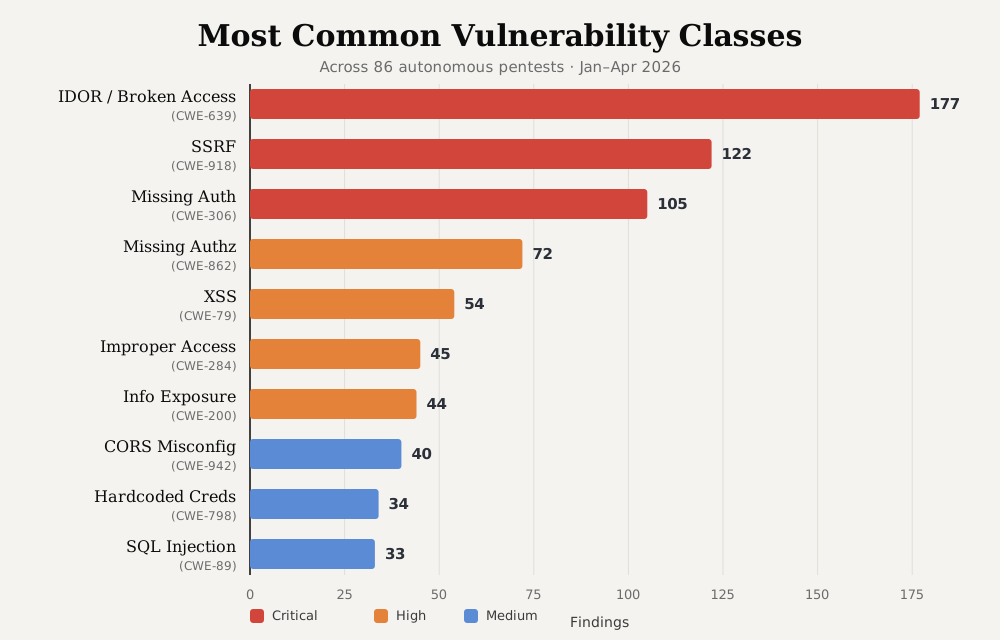
The ten most common vulnerability classes from autonomous pentests, colored by severity. Broken access control (IDOR) tops the list by a wide margin.
These are not simple bugs
Look at the top of that chart and a pattern jumps out. The leaders are logic flaws, not misconfigurations. A logic flaw means the system is doing exactly what it was coded to do, but the design itself is insecure. The bug lives in how the application works: how data flows, how permissions are enforced, and how services decide to trust each other.
- IDOR (Insecure Direct Object Reference), 177 findings. Change an identifier such as a user ID or file ID and you reach data that belongs to someone else. At scale this leaks sensitive records and can escalate to full account takeover.
- SSRF (Server-Side Request Forgery), 122 findings. Trick the server into making requests on the attacker's behalf, often against internal systems, and you can reach private APIs, cloud credentials, or infrastructure that was never meant to be public.
- Missing authentication, 105 findings. Sensitive endpoints exposed without a login mean anyone on the internet can trigger protected functionality or read protected data.
These are dangerous precisely because they exploit behavior, not configuration. Traditional scanners struggle here: they look for signatures, not logic, so an app that behaves exactly as written but trusts the wrong input sails straight past them.
Why AI is finding more
Until recently, finding and exploiting flaws like these took time, skill, and patient manual effort. That has changed. AI agents can now interact with an application the way a human attacker would, but at a completely different scale. They do not just scan endpoints, they explore them: testing edge cases, chaining several steps together, and iterating quickly across thousands of possibilities. They do not check only for known issues, they actively probe how the app behaves and look for a way to break it. They also never stop, never tire, and carry an enormous knowledge base into every session. That shift is what drives the consistent discovery of critical issues across the majority of scans.
Open source speeds discovery, but obscurity is not a defense
Source access changes the game. When an agent can read the code, it analyzes every path directly instead of inferring behavior from the outside. In controlled benchmark testing on the public XBow validation suite, access to source code raised detection by roughly 20 percent over black-box testing. With full visibility, agents trace data flows end to end, spot broken assumptions in business logic, and reach edge cases faster, which makes logic flaws far easier to surface.
That is not an argument for going closed source. A determined attacker with enough compute and enough tokens to burn can still enumerate, fuzz, and eventually find exploitable paths without the code. Security through obscurity has never been a real defense. The takeaway is not open versus closed, it is that point-in-time assessments miss the mark either way when codebases and attack surfaces both evolve at machine speed.
Speed collapses cost, and that is the real problem
A few years ago, exploiting a vulnerability demanded time and expertise. Today that timeline has collapsed. Agents run thousands of tests in parallel, continuously explore new code paths, and chain exploits automatically, so bugs get discovered within hours or days of shipping. Most organizations have not adapted. Security testing is still treated as a yearly or quarterly event, and remediation moves slower still, waiting on prioritization, engineering bandwidth, and release windows.
Vulnerabilities are discovered at machine speed. Fixes ship on human timelines. That gap is the real attack surface.
If a critical bug lives for days or weeks before it is patched, how it was found stops mattering. It is exploitable. The old "test, report, fix later" model does not hold when both attackers and discovery systems run continuously.
What actually works
The shift is not really about tools, it is about approach: moving from point-in-time testing to continuous testing. In practice that means rethinking where security sits in the development lifecycle. Continuous programs tend to combine a few things:
- Automated systems that test constantly, not once a year.
- Security wired directly into CI/CD pipelines.
- Developers owning and fixing issues as part of their normal workflow.
- Periodic human testing for the deeper, more creative attack paths.
This is not a problem headcount alone can solve. Manual testing does not scale to the speed of modern development or modern attackers, which is why more teams are leaning on automation and, increasingly, outsourcing continuous testing to systems that run at machine speed.
The takeaway
AI is already accelerating vulnerability discovery, and attackers are not waiting for your next scheduled pentest. If your application changes daily, your testing and your ability to ship fixes have to keep up. The gap between how fast we build and how often we test is widening, and right now the attackers hold the advantage. Closing it is less about buying another scanner and more about making security continuous, owned by the people writing the code, and fast enough to match the threat.
Frequently asked questions
- What is continuous AI pentesting?
- It is security testing run by autonomous agents that probe an application the way a human attacker would, but constantly rather than once a quarter. Instead of a scheduled report, findings arrive as the code changes, each one ideally backed by a working proof of concept so it is not just a theoretical alert.
- Why do AI agents find more vulnerabilities than traditional scanners?
- Traditional scanners match signatures and known patterns, so they miss logic flaws where the app behaves exactly as coded but the design is insecure. AI agents explore behavior instead: they chain steps together, test edge cases, and iterate across thousands of possibilities, which is exactly what it takes to find issues like IDOR and SSRF.
- What is an IDOR vulnerability?
- IDOR, or Insecure Direct Object Reference, lets an attacker read or change another user's data just by altering an identifier such as a user ID or file ID in a request. It was the single most common class in this dataset, and it can expose data at scale or enable account takeover.
- Does open source make software less secure?
- Not inherently, but source access does speed up discovery: in benchmark testing, having the code raised detection by roughly 20 percent over black-box testing. The real lesson is not open versus closed. Obscurity was never a defense, so both need continuous testing rather than periodic assessments.